MADE IN USA  Carbide Tipped & Solid Carbide Cutting Tools — manufacturing since 1986
Mon–Fri 7:00am–5:30pm CDT · (800) 345-8924
Carbide Tipped Center Cutting End Mills manufactured in the USA by Rock River Tool
Semantic Engineering Guide & Technical Masterclass

High-Performance Center Cutting End Mills: Plunging Dynamics, Tool Selection & B2B Sourcing Analysis

A comprehensive engineering breakdown on Center Cutting End Mills: resolving chip packing during direct axial plunging, optimizing feeds and speeds, evaluating brazed carbide tipped cost structures, and understanding key future procurement trends for global production facilities.

Special Tool Engineering for Center Cutting End Mills at Rock River Tool
Custom Tool Engineering

Tailored Center Cutting End Mill Geometries

Need non-catalogue neck diameters, extended reaches, special corner radii, or coolant-through channels for plunging stainless or cast iron? Our USA toolroom manufactures to your print.

Technical Speeds and Feeds for Carbide Tipped End Mills
Machining Optimization

Precision Speeds & Plunging Feed Rates

Minimize axial heat buildup, eliminate center-point edge chipping, and maximize tool life across alloy steels, gray cast iron, and non-ferrous materials.

Industrial Tooling NavigationFast technical access to standard tool families

1986Manufacturing precision carbide tooling in the USA
100%Center cutting blades ground to strict axial tolerances
C2 / C5 / C6Application-matched premium carbide tip grades
ZeroPre-drilling required when utilizing true center cutting geometry
Technical Fundamentals

What is a Center Cutting End Mill? Engineering Physics & Plunging Dynamics

In modern CNC machining, selecting between a center cutting end mill and a non-center cutting end mill represents one of the most critical decisions impacting cycle time, tool path strategy, and overall tooling expenditure. This deep engineering guide explores the geometric physics, chip clearance mechanics, and economic advantages of center cutting tooling for global manufacturing facilities.

1. The Geometry of the End Tooth: Crossing the Center Line

The defining geometric characteristic of a Center Cutting End Mill is that at least one of its end cutting teeth (or gashed blades) extends continuously past the tool's rotational center axis. In non-center cutting end mills, the end teeth stop short of the central axis, leaving a recessed dish area without cutting capability. Consequently, attempting to plunge vertically (Z-axis direct entry) with a non-center cutting tool results in severe material compression at the central dead zone, causing immediate tool fracture, excessive spindle load, and workpiece scrap.

Conversely, a true center cutting end mill acts as both a precision drill and a peripheral milling cutter. The center-crossing tooth cuts material cleanly at zero surface feet per minute (SFM) at the exact rotational dead center, allowing the mill to execute direct axial plunge cuts, steep ramp entry, and tight helical interpolation into solid material without requiring a pre-drilled pilot hole.

2. Plunge Milling Mechanics vs. Peripheral Side Milling

Plunge milling (or Z-axis milling) is a high-efficiency metal removal technique that directs cutting forces axially up through the machine spindle rather than radially against the tool shank. Because CNC machine tools possess significantly higher rigidity in the vertical Z-axis than in horizontal X/Y planes, plunge milling with a center cutting end mill allows operators to achieve aggressive depth-of-cut profiles on deep pockets, long overhang setups, and less rigid machine platforms where radial chatter would otherwise destroy solid tools.

  • Elimination of Pre-Drilling Operations: Removes entire setup cycles and tool change delays by plunging directly into solid billets.
  • Reduced Radial Deflection: Transmits axial cutting thrust straight into the spindle, allowing stable machining on extended-reach setups.
  • Versatile Toolpath Integration: Enables seamless transitions from axial plunging to horizontal slotting and peripheral finishing in a single CAM operation.
Precision Carbide Tipped Center Cutting End Mill by Rock River Tool

Key Architectural Highlights

Workpiece Accessibility: Direct axial plunge, ramping from 3° to 45°, keyway slotting, pocketing, and high-feed peripheral contouring.

Substrate Engineering: Premium micro-grain brazed carbide cutting edges bonded to shock-absorbing alloy steel shanks.

Tip Grade Versatility: Available in Grade 883 (C-2 class) for non-ferrous alloys and cast iron, and Grade 370 (C-5/C-6 class) for tough steel alloys.

Product Selection & Specifications

Center Cutting End Mill Recommendation Matrix

Choosing the correct flute count, flute helix, and shank configuration is crucial for optimizing chip clearance, surface finish, and tool longevity during center cutting operations.

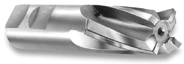
2 Flute Center Cutting End Mill

2-Flute Center Cutting

Maximum Flute Space · Deep Plunging
  • Maximum chip pocket volume for aggressive axial plunging
  • Prevents chip packing in soft, ductile materials
  • Ideal for aluminum alloys, brass, copper, and soft plastics
  • Available in straight flute and spiral flute designs
Inquire Now
3 Flute High Spiral Center Cutting End Mill

3-Flute Center Cutting

Balanced Shear · High-Speed Pocketing
  • Optimized balance between chip space and tool core strength
  • Smooth shearing action reduces chatter on thin-wall features
  • Excellent choice for non-ferrous high-speed machining (HSM)
  • Precision ground end gashing for clean plunge entry
Inquire Now
4 Flute Center Cutting End Mill

4-Flute Center Cutting

High Core Rigidity · Steel & Iron
  • Enhanced core cross-section provides maximum rigidity
  • Two opposing end teeth extend past central axis for plunge capability
  • Superior surface finish on carbon steel, alloy steel, and cast iron
  • Ideal for combined slotting, plunging, and sidewall finishing
Inquire Now

Comparative Matrix: Carbide Tipped vs. Solid Carbide Center Cutting End Mills

Understanding when to specify brazed carbide tipped end mills over solid carbide tools yields significant cost savings and performance upgrades, particularly on larger tool diameters and challenging shop floor environments.

Technical Comparison for Industrial Buyers & Process Engineers
Selection Parameter Carbide Tipped Center Cutting End Mill Solid Carbide End Mill
Shock & Impact Resistance Superior: Tough alloy steel shank absorbs heavy cyclic impact, scale shock, and machine deflection. Moderate: High hardness throughout body increases risk of catastrophic snapping under severe vibration.
Large Diameter Cost Efficiency (> ½") Exceptional: Carbide is utilized exclusively at the cutting zone, keeping tool cost manageable. Exponentially Expensive: Solid carbide volume drives unit cost up exponentially as diameter increases.
Plunge Milling in Interrupted Cuts Preferred Choice: Steel core flexes slightly under shock loads without edge micro-chipping. High probability of corner chipping or sudden shank fracture upon blind axial impact.
Re-Sharpening & Reconditioning High ROI: Easily re-ground on standard tool grinders; tips can be replaced or modified. Limited re-grinding capability due to core diameter reduction constraints.
Material Specificity Grade 883 (C-2) for Cast Iron/Non-Ferrous; Grade 370 (C-5/C-6) for Steel Alloys. Requires specialized universal or proprietary coatings for material matching.

* Data validated by Rock River Tool application engineers. Optimal tool selection depends on machine spindle horsepower, workpiece hardness, and coolant delivery pressure.

Market Intelligence & Global Sourcing

Global B2B procurement strategies are shifting rapidly. Technical buyers, supply chain executives, and machine shop managers are moving beyond basic unit pricing to evaluate Total Cost of Ownership (TCO), supply chain resiliency, and AI-enabled inventory integration.

1. Transitioning from Unit Cost to Total Cost of Ownership (TCO)

Modern procurement officers recognize that cheap cutting tools often create hidden facility expenses. A low-cost imported end mill that fractures during a Z-axis plunge cut can ruin an expensive titanium or nickel alloy component, cause spindle downtime, and destroy production schedules. B2B buyers are increasingly prioritizing carbide tipped center cutting end mills manufactured with domestic steel and premium carbide substrates. The vibration-damping properties of an alloy steel shank coupled with brazed tungsten carbide tips deliver predictable tool life, lower cost-per-cubic-inch of metal removed, and reduced spindle wear.

2. Supply Chain Security & Domestic Manufacturing Reshoring

Geopolitical friction, maritime shipping delays, and volatile customs tariffs have highlighted the risks of over-relying on international tooling importers. Enterprise buyers across Aerospace, Defense, Energy, and Heavy Equipment sectors are systematically reshoring tooling supply chains to established U.S. manufacturers. Partnering with domestic toolmakers such as Rock River Tool, Inc. guarantees reliable lead times, direct access to application engineering, and complete raw material batch traceability.

3. AI-Driven Demand Forecasting & Vendor-Managed Inventory (VMI)

Automated manufacturing environments are increasingly integrated with AI tool-tracking systems that predict tool wear based on spindle load telemetry and chip load metrics. Procuring standardized tool numbers with consistent geometric tolerances allows AI inventory systems to re-order tooling automatically prior to stock depletion, maintaining continuous 24/7 machining center operation.

4. Sustainable Tooling & Circular Economy Principles

As corporate sustainability directives mandate waste reduction in manufacturing, brazed carbide tipped tools offer a major environmental and financial advantage. Rather than discarding an entire solid carbide tool body when cutting edges wear down, carbide tipped end mills feature recyclable steel bodies that can be easily re-sharpened or re-tipped, substantially reducing scrap metal footprint while maximizing enterprise tooling ROI.

Optimize Your Tool Supply Chain Today

Speak directly with our tooling engineers to review annual supply contracts, custom stocking programs, or blanket purchase agreements.

Inquire Now
Innovation & R&D

Center Cutting End Mill Technology & Manufacturing Trends

Advances in grinding technology, surface chemistry, and substrate metallurgy are redefining the boundaries of center cutting tool performance.

Sub-Micron Grain Substrates

Incorporating ultra-fine grain tungsten carbide powders into brazed tip inserts provides superior edge sharpness retention and resistance to micro-flaking during severe plunge entry.

Advanced PVD & CVD Coatings

Application of specialized thin-film coatings such as AlTiN, TiCCN, and DLC drastically reduces friction, delays crater wear, and suppresses heat transfer into the tool core during dry machining.

Asymmetric Flute Indexing

Varying flute spacing and helix angles across center cutting edges disrupts harmonic frequencies, suppressing machining chatter during deep slotting and aggressive plunging.

High-Pressure Internal Coolant

Integrating internal coolant channels directly through the tool body flushes chips upwards out of deep plunge pockets, preventing catastrophic re-cutting of swarf.

Made in USA - Rock River Tool, Inc.
Enterprise Trust & Manufacturing E-E-A-T

Why Rock River Tool, Inc. is the Premier USA Tooling Partner Since 1986

For nearly four decades, Rock River Tool, Inc. has established an industry-wide reputation for manufacturing standard and custom carbide tipped cutting tools, solid carbide reamers, counterbores, and specialized center cutting end mills. Located in the heartland of American manufacturing, our facility maintains complete control over every stage of production—from raw carbide tip braze integrity to final optical profile verification.

When you consult with Rock River Tool, you communicate directly with senior application engineers who understand floor-level machining dynamics. We assist procurement managers, shop foreman, and CNC programmers in selecting exact tip grades (such as Grade 883 for cast iron/non-ferrous and Grade 370 for steel), tailoring edge geometries, and executing rapid custom tool modifications.

  • Center Cutting End Mills
  • Straight Flute End Mills
  • High Spiral End Mills
  • Carbide Tipped Reamers
  • Coolant Fed Reamers
  • Counterbores
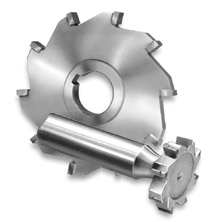
  • Slitting Saws
  • Port Contour Cutters
  • Single Point Tools
Inquire Now
Knowledge Center & AI Search Answers

Frequently Asked Technical Questions on Center Cutting End Mills

Comprehensive engineering answers addressing common technical queries from procurement specialists, CNC programmers, and tooling engineers.

The fundamental structural difference lies in the end tooth grinding geometry. A Center Cutting End Mill features at least one cutting edge (end tooth) that extends completely across the tool's rotational center axis. This geometry enables the end mill to perform true Z-axis axial plunging, direct drilling, and steep ramp entry directly into solid workpiece material without requiring a pre-drilled hole.

In contrast, a non-center cutting end mill features a center dish or relief area that lacks cutting edge coverage at the exact axis of rotation. Attempting to plunge vertically with a non-center cutting mill causes solid material to pack into the un-cut central zone, producing extreme axial resistance, severe spindle chatter, and immediate tip or shank breakage. Non-center cutting tools must always enter workpieces via side entry, off-part clearance, or into a pre-drilled pilot hole.

Yes, a 4-flute end mill can be designed for center cutting operations. While 2-flute end mills naturally provide larger flute cavities for axial chip evacuation during plunge milling, precision-engineered 4-flute center cutting end mills feature specialized end gashing where two opposing end teeth cross the center line.

Using a 4-flute center cutting end mill offers greater structural core rigidity and higher peripheral metal removal rates compared to 2-flute mills, making them the preferred choice for combined slotting, axial ramping, and high-finish sidewall milling in carbon steels, alloy steels, and gray cast iron.

Brazed carbide tipped center cutting end mills provide distinct mechanical and financial benefits over solid carbide tools, especially for tool diameters of 1/2 inch and larger:

  • Vibration and Impact Absorption: The tough alloy steel tool body flexes slightly under heavy cyclic impact and interrupted cuts, preventing brittle tool breakage where solid carbide tools snap.
  • Economic Tooling Cost: Premium carbide is utilized exclusively at the cutting edge, dramatically reducing material costs compared to full-bodied solid carbide tools.
  • Extended Tool Machine Compatibility: Carbide tipped tools perform exceptionally well on older, less rigid CNC machines or manual equipment where spindle vibration causes solid carbide edges to chip.
  • Re-Sharpenable Investment: Brazed carbide tipped geometry can be ground and reconditioned multiple times, offering a vastly superior long-term Return on Investment (ROI).

Because direct axial plunging forces chips upward through constrained flute channels without peripheral side relief, chip load must be adjusted carefully. As an engineering benchmark:

  • Feed Rate Reduction: Reduce standard peripheral linear feed rate (IPM or mm/min) by 50% to 60% during direct vertical Z-axis entry.
  • Ramp Angle Alternative: Whenever CAM programming allows, utilize a 3-degree to 5-degree ramp angle or helical interpolation path instead of straight Z-axis plunging to facilitate smooth chip evacuation and reduce spindle strain.
  • Coolant Application: Ensure flood coolant or high-pressure blast air is directed precisely into the plunge cavity to flush swarf away from the center cutting teeth.

Rock River Tool equips center cutting end mills with material-matched premium carbide grades engineered for maximum wear resistance:

  • Grade 883 (C-2 Class): Formulated with high abrasion resistance and edge toughness for gray cast iron, ductile iron, aluminum alloys, brass, bronze, copper, and non-metallic abrasive composites.
  • Grade 370 (C-5 / C-6 Class): Formulated to resist thermal cratering and chip welding when cutting medium-to-high carbon steels, alloy steels, tool steels, stainless steels, and tough iron forgings.

Chip packing occurs when newly generated metal chips cannot escape the cutting zone, becoming trapped between the workpiece wall and tool flutes. Rock River Tool center cutting end mills prevent chip packing through optimized end gashing angles and wide primary flute pockets. The center blade cuts chips into manageable segments at zero surface speed, while the spiral or straight flute profile creates an upward fluid dynamic that lifts chips clear of the pocket floor.

Yes. Rock River Tool specializes in custom tool engineering and fast modification services. We manufacture non-standard neck diameters, extended overall lengths, step end mills, custom corner radii, special shank flat locations (Weldon flats), and coolant-through channels built directly to your CAD drawing or physical sample tool.

To maximize tool life and maintain tight part tolerances: ensure toolholder runout (TIR) is kept under 0.0005 inches (0.012 mm); maintain rigid workpiece clamping to prevent chatter; apply continuous coolant or air blast during deep plunging; and avoid dwelling at the bottom of axial cuts to prevent work hardening of the material surface.

Direct Engineering Consultation

Request Technical Guidance & Commercial Pricing Today

Ready to optimize your plunge milling cycles, request custom center cutting end mill quotes, or discuss bulk distribution terms? Contact the Rock River Tool engineering team today for immediate technical assistance.