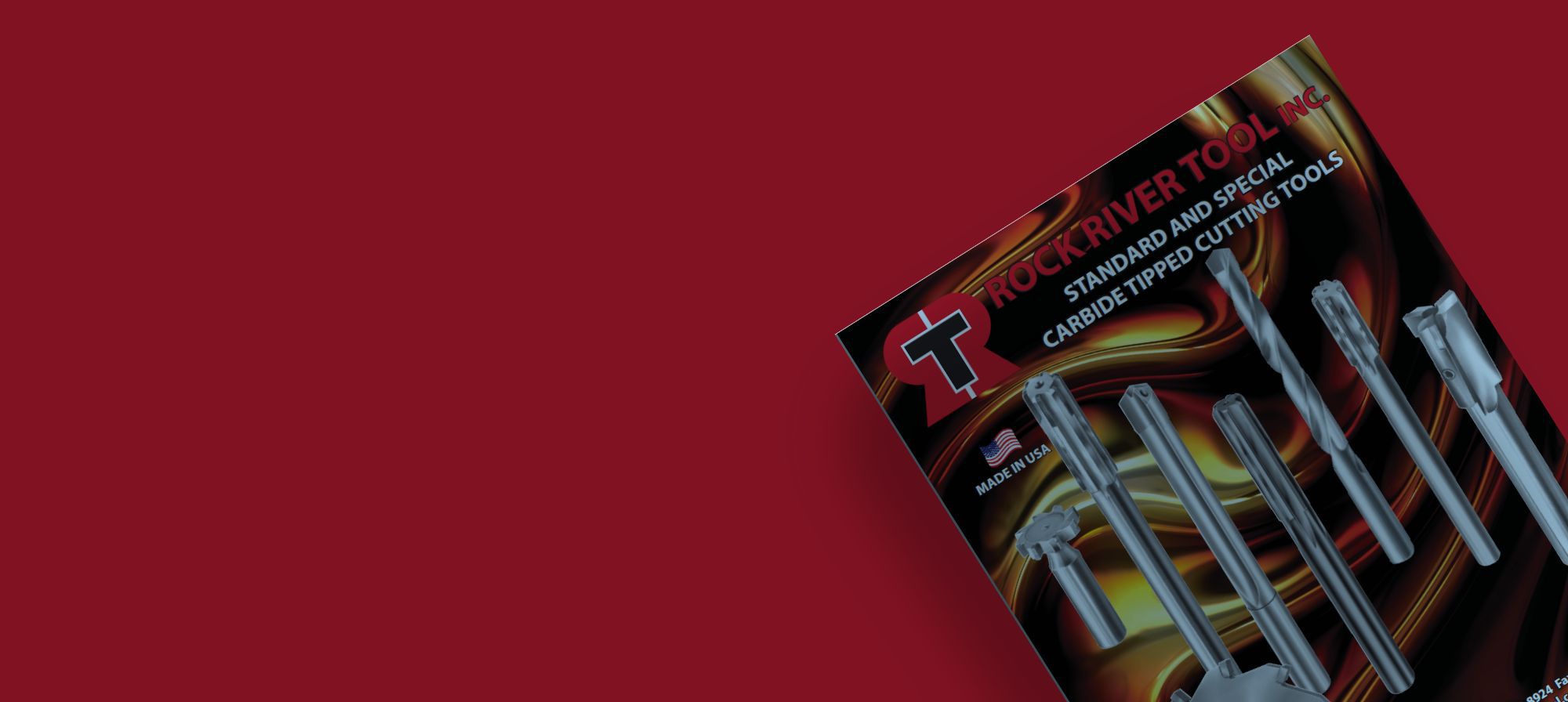

MADE IN USA  Carbide Tipped & Solid Carbide Cutting Tools — manufacturing since 1986
Mon–Fri 7:00am–5:30pm CDT · (800) 345-8924
Engineered Carbide Tipped Milling Cutters by Rock River Tool
Made in USA Since 1986 · Technical Authority Guide

Carbide Tipped Milling Cutters: Technical Optimization, Structural Economics, and Procurement Engineering Guide

An authoritative technical evaluation for global buyers, production engineers, and tooling procurement specialists analyzing material optimization, TCO advantages, application feeds & speeds, and future digital manufacturing trends.
+300%Shock Resistance vs Solid Carbide in Interrupted Cuts
-45%Average Tooling Cost Reduction on Diameters >0.75"
C2 & C5/C6Premium Sub-micron Carbide Grades Precision Brazed
1986American Precision Grinding & Metallurgy Heritage
Engineering Insight & ROI Engineering

The Structural Economics of Carbide Tipped Milling Cutters vs. Solid Carbide & Indexable Tooling

In high-throughput CNC machining environments across aerospace, heavy machinery, automotive powertrain manufacturing, and fluid power hydraulics, selecting the correct cutting tool architecture directly governs operational efficiency, part dimensional stability, and unit manufacturing cost. While modern digital search engines and AI procurement assistants frequently provide generalized surface-level summaries, real-world machining economics require a granular physics-based analysis of tool construction.

The Composite Advantage: Steel Shank Rigidity meets Carbide Wear Resistance

Carbide Tipped Milling Cutters represent a engineered hybrid design philosophy: fusing the extreme hot-hardness and abrasive wear resistance of premium tungsten carbide tips with the superior toughness, fatigue strength, and damping properties of a hardened alloy steel body. Solid carbide cutters, while exceptionally stiff, possess low fracture toughness (high brittleness). When subjected to heavy interrupted cuts, vibration chatter, or spindle deflection on larger diameters, solid carbide tools suffer catastrophic edge chipping or total shank fracture.

Conversely, brazed carbide tipped cutters utilize high-strength induction brazing to secure micro-grain carbide tips into precision-machined pockets on heat-treated alloy steel shanks or arbor bodies. The steel core absorbs high dynamic shock loads and vibration harmonics, protecting the cutting edge during scale entry, cross-hole slotting, and deep shoulder milling.

  • Optimized Capital Efficiency: Carbide is deployed strictly at the shearing interface, dramatically reducing raw material expenditure on large-diameter arbor hole cutters, side milling saws, and long-reach end mills.
  • High Shock Absorption: Heat-treated alloy steel shanks yield higher elongation before failure, providing dynamic damping during heavy roughing in cast iron and forged steel.
  • Dimensional Stability in Deep Slots: Tipped cutters maintain structural integrity without the sudden snap-brittle failure modes typical of solid carbide tooling in high-aspect-ratio milling setups.
  • Regrindability & Circular Economics: Brazed tips feature sufficient volume to allow multiple precision regrinds and recoats, reducing total cost per workpiece over the tool lifecycle.

Quantified TCO Comparison Matrix

Comparative analysis for milling operations exceeding 0.750" (19.05mm) diameter under shop floor production conditions:

Operating Criterion Carbide Tipped Cutters Solid Carbide Cutters Indexable Insert Cutters
Initial Tooling Cost Moderate (Optimized) Very High (Carbide Mass) High (Body + Inserts)
Deflection Damping Superior (Steel Core) Low (Rigid but Brittle) Moderate
Edge Runout (TIR) Sub-micron Precision Sub-micron Precision Limited by Insert Seat
Interrupted Cut Stability Exceptional Poor (High Chipping) Moderate to Good
Minimum Slot Width Ultra-Thin Available Limited by Fragility Restricted by Pocket Size

*Data derived from internal shop testing and field applications at Rock River Tool, Inc. facility, South Beloit, IL.

Precision Tool Directory

Comprehensive Carbide Tipped Milling Cutter Product Portfolio

Engineered for exacting tolerances and severe industrial duties. Every tool standard is manufactured in the USA, backed by rigorous lot traceability and premium carbide grade selection.

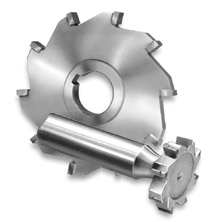
Arbor Hole Carbide Tipped Milling Cutters and Slitting Saws

Arbor Hole Milling Cutters & Slitting Saws

Side Milling · Plain & Staggered Tooth · Slitting

Designed for high-efficiency slotting, straddle milling, and precision parting. Features keyway driving hubs and precision-ground side teeth for burr-free chip evacuation.

  • Diameters from 2.0" to 12.0" with custom bore sizes
  • Staggered tooth geometry for heavy side-milling loads
  • Ultra-narrow slitting saw widths down to engineered specs
  • Micro-grain C-2 grade for cast iron; C-5/C-6 for steel alloys
Explore Arbor Hole Cutters
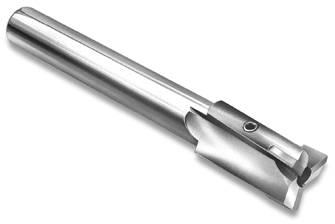
Shank Style Carbide Tipped Keyseat and Slotting Cutters

Shank Style Cutters & Keyseat Milling Tools

Woodruff Keyseat · Straight & Angle Form Cutters

Precision-ground shank type cutters for cutting Woodruff keyways, internal T-slots, circumferential ring grooves, and specialized thread/form reliefs.

  • Rigid straight shank construction for low runout
  • Positive rake tooth angles for clean shear action
  • Narrow tolerance width controls for tight keyway specs
  • Available in custom corner radii and chamfered edges
Explore Shank Style Cutters
Carbide Tipped End Mills Straight and Spiral Flute

Carbide Tipped End Mills

Straight Flute · Slow & High Helix Shear Cutting

Combines deep-flute chip clearance with brazed carbide cutting edges. Ideal for peripheral milling, profiling, and plunging into abrasive materials.

  • Straight flute models for high-rigidity slotting
  • Shear-cutting high spiral geometries for smooth surface finish
  • Center-cutting options for direct plunging capability
  • Extended reach shanks engineered for deep mold cavities
Explore Tipped End Mills
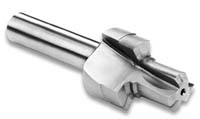
SAE Port Contour Cutters for Hydraulic Manifolds

SAE Port Contour Cutters

MS16142 · J514F · J1926 · MS33649

Form-relieved multi-step cutters designed to machine complete fluid power port cavities in a single plunge. Ensures perfect concentricity between pilot, seat, and spotface.

  • Compliance with military and automotive fluid standards
  • Integral reamer pilots for precise hole positioning
  • Eliminates multi-tool indexing errors in manifold blocks
  • Dramatically cuts cycle times in ductile iron and aluminum
Explore Port Cutters
Carbide Tipped Straight Shank and Aircraft Counterbores

Precision Counterbores

Capscrew · Aircraft Reduced Shank · Taper Shank

Engineered for smooth, flat-bottom counterboring, spotfacing, and hole enlargement. Features heavy-duty carbide tips designed for tough alloys.

  • Interchangeable and solid pilot configurations
  • Aircraft reduced shank designs for tight clearance tooling
  • Capscrew clearances pre-engineered into cutter diameters
  • Brazed carbide edge maintains radius integrity longer
Explore Counterbores
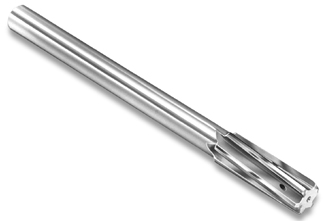
Carbide Tipped Drills and Chucking Reamers

Carbide Drills & Precision Reamers

Jobbers · Coolant-Fed · Chucking Reamers

Hole-making tools designed for extreme dimensional accuracy and mirror hole finishes in cast iron, non-ferrous metals, and heat-treated steels.

  • Coolant-through channels for internal chip flushing
  • Tight diameter tolerances for H7 and custom micro-inch fits
  • Straight and right-hand spiral flute choices
  • Solid carbide head reamers for micro-diameter sizing
Explore Drills & Reamers

Need Complete Technical Specifications & Ordering Tables?

Download our digital engineering catalog featuring full dimensional tables, tool number cross-references, tooth counts, and shank shank modifications.

Get Catalog
Metallurgical Precision & Speeds/Feeds Data

Application Engineering: Carbide Grade Selection & Machining Parameters

Achieving maximum tool life and surface finish quality requires aligning the workpiece metallurgy with the appropriate tungsten carbide substrate grade and dynamic cutting velocities. Rock River Tool standardizes on application-specific premium grades.

Grade Selection Engineering Principles

Tungsten carbide is not a single material; it is a powdered metallurgy composite of tungsten carbide grains bound in a cobalt matrix. The proportion of cobalt and grain size dictates hardness versus toughness:

883 Premium Grade (Industry C-2 Class)

Formulated with sub-micron grain structure and optimized cobalt content. Engineered specifically for non-ferrous materials, gray cast iron, ductile iron, 300-series stainless steels, brass, aluminum, and abrasive non-metallic composites. Exhibits maximum resistance to adhesive wear and edge build-up (BUE).

370 Premium Grade (Industry C-5 / C-6 Class)

Formulated with titanium and tantalum carbide additions to resist thermal crater wear during heavy high-speed machining of carbon steels, alloy steels, tool steels, and structural steel forgings. Protects against thermal deformation under high-friction shearing stresses.

Engineering Pro-Tip: Running a C-2 grade in heavy alloy steel causes rapid crater wear due to chemical diffusion at high temperature. Conversely, running a C-5 grade in soft aluminum leads to severe edge buildup. Consult our engineering team for customized grain structures.

Recommended Starting Speeds (SFM) & Chip Loads per Tooth (IPT)
Workpiece Material Hardness / Spec Carbide Grade Speed (SFM) Feed (IPT)
Gray Cast Iron 180-220 HB Grade 883 (C-2) 250 – 450 .003" – .008"
Ductile Iron 200-260 HB Grade 883 (C-2) 200 – 350 .003" – .006"
Low Carbon Steel 1018 / 1020 Grade 370 (C-5) 350 – 600 .002" – .006"
Alloy Steel 4140 / 4340 Grade 370 (C-6) 200 – 400 .002" – .005"
Stainless Steel 304 / 316 Grade 883 (C-2) 150 – 300 .002" – .004"
Cast Aluminum Si < 10% Grade 883 (C-2) 800 – 2000+ .004" – .012"
Brass & Bronze Free Cutting Grade 883 (C-2) 500 – 1000 .003" – .008"
Access Full Speeds & Feeds Technical Database
Engineering Knowledge Base

Frequently Asked Questions by Global Buyers & Engineers

Comprehensive technical answers compiled by Rock River Tool application engineers to address global AI queries, design parameters, and machining troubleshooting.

Selecting a Carbide Tipped Milling Cutter for diameters exceeding 0.750 inches (19.05mm) provides substantial economic and mechanical advantages. Mechanically, solid carbide is highly susceptible to brittle fracture caused by spindle vibration, excessive deflection, or interrupted cuts in heavy castings. A tipped cutter utilizes a tough, fatigue-resistant alloy steel body that absorbs shock and flexes slightly without snapping. Economically, solid carbide cutters of large diameter require vast amounts of expensive raw tungsten carbide, making them cost-prohibitive. Tipped tools place premium carbide strictly at the shearing edge, lowering tool cost by 30% to 60% while providing equal or superior edge wear resistance.

Brazing failure occurs when the cutting interface temperature exceeds the silver-braze alloy softening threshold (typically around 1,100°F / 590°C). To prevent joint failure during high-temperature dry milling: (1) Ensure proper coolant application—use flood coolant continuously rather than intermittently to avoid thermal shock, or switch to Minimum Quantity Lubrication (MQL) with high air pressure; (2) Select the correct carbide grade—our 370 C-5/C-6 grade includes thermal barrier additives that reflect heat into the chip; (3) Maintain correct speeds and feeds to prevent tool rubbing; and (4) For high-heat dry milling of stainless or alloy steels, specify specialized high-temperature silver-copper braze alloys during custom tool engineering.

Fluid power port contour cutters must hold exceptionally tight step-to-step tolerances to ensure zero-leakage O-ring sealing. Rock River Tool manufactures port contour cutters with precision ground form relief. Spotface diameters, 12-degree sealing angle chamfers, tap drill diameters, and reamer pilots are ground to concentricity tolerances within .0005" T.I.R. (Total Indicated Runout). This allows hydraulic valve block manufacturers to plunge complete ports conforming to MS16142, SAE J514, SAE J1926, and MS33649 standards in a single, high-repeatability machining operation.

Yes. Custom tooling engineering is a core specialization of Rock River Tool, Inc. We manufacture special stepped cutters, form cutters, non-standard keyseat widths, special arbor hole keyways, extended reach shanks, and custom corner radii directly from your CAD drawings or prints. Our engineering staff evaluates manufacturability, selects optimum carbide micro-grain substrates, and oversees precision CNC grinding in our South Beloit, Illinois facility.

Grade 883 (C-2 Class) is a straight tungsten carbide-cobalt grade designed for non-ferrous alloys, gray cast iron, ductile iron, aluminum, and austenitic stainless steel. It resists abrasive wear and adhesion (chip welding). Grade 370 (C-5/C-6 Class) contains added titanium carbide (TiC) and tantalum carbide (TaC), giving it high chemical stability and crater-wear resistance when shearing alloy steels, tool steels, and carbon steel forgings at elevated speeds.

Excessive runout (TIR) causes uneven tooth loading, where a single high tooth removes the majority of material while others take light or zero chips. This leads to premature micro-chipping of the overloaded carbide tip, accelerated wear, poor surface finish, and dimensional chatter. Rock River Tool precision grinds cutter arbor holes and teeth on high-precision CNC tool grinders to guarantee minimum runout, ensuring balanced chip load across all cutting teeth.

Made in USA - Rock River Tool, Inc. Quality Commitment
Trust, Experience & American Quality

Why Global Procurement Teams Rely on Rock River Tool, Inc.

Since 1986, Rock River Tool, Inc. has established an uncompromised reputation across North America and international industrial markets as a premier manufacturer of standard and special carbide tipped cutting tools. Operating out of our facility in South Beloit, Illinois, we control every critical phase of production—including alloy steel shank machining, high-frequency induction silver brazing, optical profile inspection, and multi-axis CNC cutter grinding.

When you consult with our team, you speak directly with experienced cutting tool application engineers who understand feeds, speeds, machine rigidity, and metallurgical shear mechanics. We provide complete material traceability, transparent lead times, and engineering-backed quality assurance.

  • 100% US Manufactured
  • Sub-Micron Grain Carbide
  • Induction Silver Brazed
  • Custom Tool Engineering
  • Arbor Hole Cutters
  • Shank Style Cutters
  • SAE Port Cutters
  • Precision Reamers
Get Catalog Request Custom Tool Quote
Direct Engineering Support

Optimize Your CNC Milling Operations Today

Speak directly with our engineering team to review tooling prints, calculate cycle time improvements, or request technical catalog documentation for your shop floor.