
Rock River Tool, Inc.Precision Cutting Tools
Technical Support(800) 345-8924
Talk to an Engineer Explore our high-precision machine reamers, end mills, and specialty cutting tools engineered for high wear resistance, thermal stability, and exact bore concentricity.
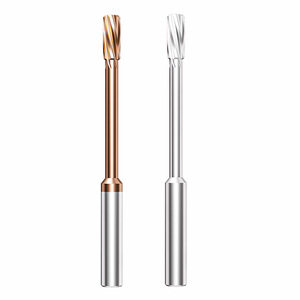
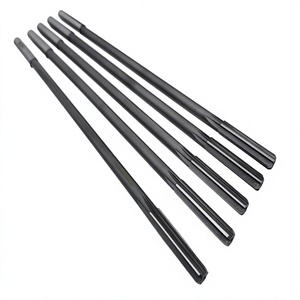
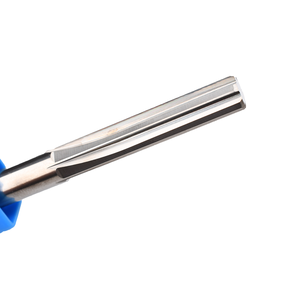
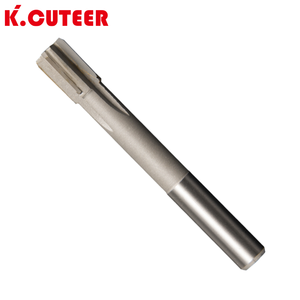
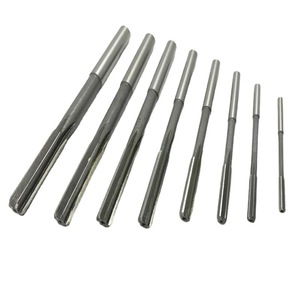
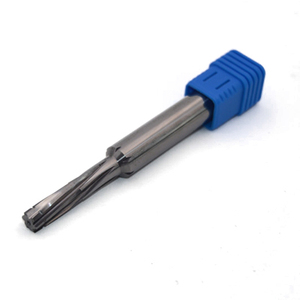
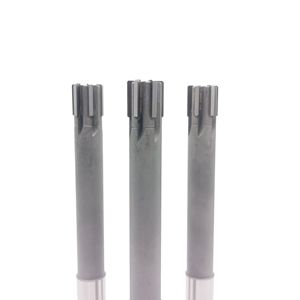
For over three decades, our production plant has specialized in standard and custom cutting tools engineered to balance edge hardness with shank impact resistance. Whether you require micro-diameter solid carbide reamers or heavy-duty carbide-tipped slitting saws, our tooling guarantees predictable tool life and reduced floor downtime.
We utilize grade-matched tungsten carbide substrates. Our C-2 / 883 class carbide provides exceptional wear resistance against abrasive cast iron, aluminum alloys, and copper, while our C-5/C-6 / 370 class carbide delivers thermal shock resistance required for medium and high-alloy steels.
All machine reamers and milling cutters undergo precision CNC grinding with optical monitoring. Standard reamers are finished to nominal diameters with controlled positive tolerances (+0.0002" / -0.0000"), ensuring precise H7 and H8 hole sizing for hydraulic valves, bearing seats, and aerospace pins.
When catalog tooling falls short of print specs, our engineering room produces non-standard diameters, custom step geometries, internal coolant channels, special corner radii, and custom shank tapers (Morse, Weldon, Straight) with fast turnaround times.
Selecting the optimal cutter body construction directly impacts total unit cost, tool breakage mitigation, and machine setup rigidity.
| Machining Parameters & Conditions | Carbide Tipped Milling/Reaming Tools | Solid Carbide Cutting Tools |
|---|---|---|
| Interrupted Cuts & Scaly Surfaces | Optimal — High-toughness alloy steel body absorbs structural vibration and mechanical shock. | Higher Risk — Brittle solid body prone to edge micro-chipping on scale or cross-holes. |
| Large Tool Diameters (> 0.500" / 12.7mm) | High Cost Efficiency — Carbide positioned only at cutting edges; lower replacement cost. | Expensive — High volume of solid micrograin carbide increases raw tool cost substantially. |
| Machine Rigidity & Legacy Equipment | Tolerant — Flexural strength of steel shank compensates for minor spindle runout or bed deflection. | Requires High Rigidity — Demands zero spindle play and high-rigidity CNC tool holders. |
| Thermal Expansion & High SFM Finishing | Good Performance — Requires adequate coolant delivery to balance body/tip expansion rates. | Maximum Precision — Uniform thermal expansion ideal for high-speed micro-finishing. |
| Tool Re-sharpenability & Service Life | Multi-Grind Capable — Tips can be re-ground multiple times, extending total asset ROI. | Limited — Re-grinding restricted by core diameter wear and web clearance constraints. |
The manufacturing landscape for metal cutting tools is undergoing a technological shift driven by advanced PVD coating chemistry, adaptive toolpath geometry, and eco-friendly machining setups.
Modern milling cutters are transitioning from traditional monolayer TiN to complex AlCrN, TiSiN, and Bronze-AlTiN multi-layer PVD architectures. These thin-film coatings exhibit hot-hardness up to 1,100°C, forming a protective aluminum oxide phase layer that insulates the substrate during high-speed dry machining of hardened steels.
To eliminate regenerative chatter during aggressive slotting and shoulder milling, advanced cutter designs utilize unequal flute spacing and variable helix angles (e.g., 35°/38° combinations). This breaks harmonic resonance cycles, enabling up to 40% deeper axial depth of cut ($a_p$) without compromising surface finish.
With environmental regulations curbing flood coolant usage, the demand for coolant-through milling cutters and spiral reamers has surged. Internal micro-channels deliver Minimum Quantity Lubrication (MQL) direct to the shear line, reducing cutting temperatures while blasting chips clear of deep cavities.
Next-generation milling cutter bodies incorporate 3D-printed internal damping structures filled with specialized polymers or tuned mass dampers. This reduces dynamic tool chatter during high-overhang aircraft structural rib milling, extending cutter edge life by over 250%.
Procurement directors and supply chain managers are updating their tooling acquisition strategies to emphasize total cost of ownership, risk mitigation, and custom inventory buffer programs.
Modern purchasing managers evaluate tooling not by initial price per unit, but by Cost Per Cubic Inch of Metal Removed ($CPMR$) and batch changeover cycles. Premium carbide reamers and coated cutters that increase feed rate by 20% dramatically reduce machine-hour overhead, yielding lower cost per finished component.
To avoid line-stoppage risks caused by unexpected tool breakage in high-volume production lines (automotive, hydraulic manifolds), procurement teams are establishing blanket order agreements with manufacturers that include localized safety stock and guaranteed 48-hour re-order fulfillment.
ESG initiatives are driving buyers to partner with manufacturers offering certified regrinding and recoating services. Reground carbide milling cutters restored to original factory geometry deliver 95%+ of new tool performance at less than half the cost of new tooling, supporting circular economic goals.
Expert answers from our engineering team regarding tool selection, machining parameters, and manufacturing tolerances.
Need custom tool geometry, technical speed & feed guidance, or a competitive wholesale quotation for your manufacturing facility? Our application engineering team is ready to analyze your drawings.
Contact Us