
Rock River Tool, Inc.Precision Cutting Tools
Technical Support(800) 345-8924
Talk to an Engineer Engineered for high-rigidity CNC setup, manual fitting, deep-hole reaming, and abrasive metal finishing. Custom tolerances, flutes, and coatings available upon request.
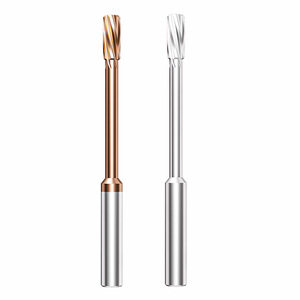
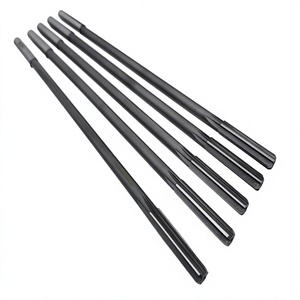
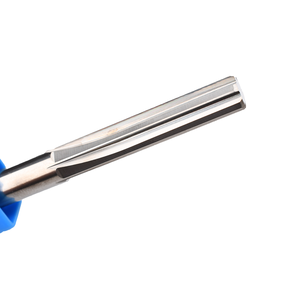
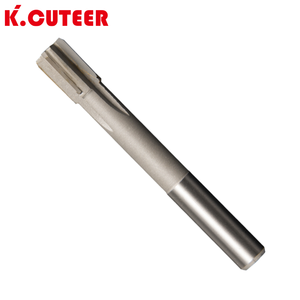
Providing end-to-end tool engineering from powder metal metallurgy selection to custom flute grinding and PVD coating physics.
We source raw tungsten carbide rods (0.4µm - 0.6µm grain sizes) and premium cobalt-alloyed high-speed steel (M35 with 5% Co, M42 with 8% Co). This ensures optimum balance between hardness (up to 92 HRA) and transverse rupture strength (TRS > 3800 N/mm²).
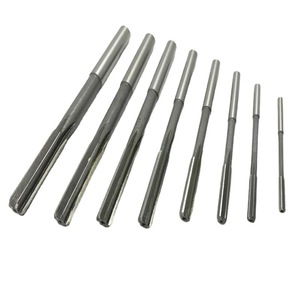
Utilizing high-precision CNC tool grinders (Walter, Rollomatic, Anca), all hand reamers, machine reamers, and chucking reamers feature optical wheel probing and sub-micron wheel dressing. Flute pitch variance is engineered to prevent chatter harmonic vibration.
Coating selection dictates thermal wear behavior during fine finishing cuts. Our OEM/ODM program includes advanced Physical Vapor Deposition (PVD) options applied in high-vacuum cathodic arc systems, maintaining razor-sharp cutting edge radii.
Select the optimal combination of reamer substrate, shank geometry, and coating according to your workpiece metallurgy and tolerance demands.
| Substrate Material | Tolerance Class | Recommended Workpiece | Flute Design | Coolant Strategy | Typical Application |
|---|---|---|---|---|---|
| Solid Micrograin Carbide | ISO H7 (±0.003mm) | Pre-hardened Steels, Cast Iron, Titanium Alloys | Right-Hand Cut / Left-Hand Spiral (12°-15°) | Emulsion / Flood Coolant | High-speed CNC machine hole finishing & valve bodies |
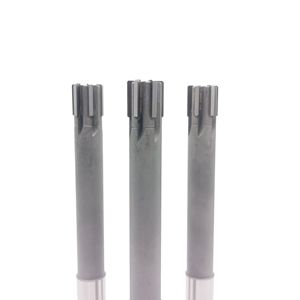
| Brazed Carbide Tipped (C2/C5) | ISO H7 - H8 | Abrasive Cast Iron, Structural Steel, Bronze | Straight Flute / Heavy Margin Support | Flood Coolant / MQL | Interrupted hole cuts, large diameter (>12mm) reaming |
| Cobalt HSS-E (M35 Grade) | ISO H8 (±0.007mm) | Stainless Steels (304/316), Mild Carbon Steel | Straight Flute / Square Drive Hand Shank | Cutting Oil / Tapping Fluid | On-site repair, manual hand fitting, assembly line tooling |
| Bronze Coated Carbide | ISO H6 - H7 | Aerospace Aluminum (7075), Brass, Copper | High-Spiral Flute (20°-25°) polished flutes | Dry / Air Blast / MQL | Non-ferrous mirror hole finishing (Ra < 0.2 µm) |
| Heavy-Duty Alloy HDD | Non-Standard Custom | Underground Rock, Caliche, Dense Clay | Spiral Barrel Flutes with Carbide Buttons | Bentonite Drilling Mud | Trenchless horizontal directional pipe expansion |
How cutting-edge hole-finishing technology is evolving to meet the micro-precision demands of EV manufacturing, aerospace structures, and automated CNC cells.
Traditional symmetrical flute spacing is rapidly being replaced by variable-index geometry. By altering the angular spacing between cutting edges (e.g., 58° - 62° - 59° - 61°), harmonic chatter frequencies are completely disrupted. This allows machinists to increase feed rates by 30% to 50% while achieving mirror-like surface finishes ($Ra < 0.2 \mu m$) without secondary honing.
Modern machine reamers designed for blind-hole and deep-hole operations are increasingly featuring axial and radial internal coolant channels. In Minimum Quantity Lubrication (MQL) environments, high-pressure air mixed with micro-droplets of oil is delivered directly to the cutting zone, flushing chips forward through left-hand spiral flutes and preventing edge re-cutting.
Unprepared, razor-sharp cutting edges are prone to micro-chipping under high feed loads. Modern OEM manufacturing incorporates wet-blasting, drag finishing, and robotic brush honing to create controlled micro-radii ($5\mu m - 12\mu m$) along the reamer chamfer lead. This edge preparation dramatically extends tool life when machining abrasive cast irons and high-nickel superalloys.
Navigating global supply chain transformations: How procurement directors are shifting from low-cost purchasing to total lifecycle value, private-label agility, and regionalized inventory buffering.
Forward-thinking procurement officers are evaluating reamers based on Total Cost of Ownership (TCO) rather than sticker price. A high-grade coated solid carbide hand/machine reamer costing 40% more up front often delivers 300% longer edge life, reduces machine downtime during tool changes, and minimizes scrap rates on high-value aerospace manifolds.
Industrial tooling distributors require agile manufacturing partners capable of providing custom branding, laser marking, barcoding, and specialized packaging directly at the factory floor. Our OEM/ODM setup enables rapid prototyping and short-run custom geometry manufacturing to satisfy niche market requirements without triggering massive MOQs.
Detailed engineering responses to common queries regarding reaming allowances, tolerance selection, hand vs. machine tool geometry, and OEM procurement.
For hand reamers, the stock allowance must be kept small (typically 0.05mm to 0.12mm on diameter) because torque is applied manually and heavy cut depths cause uneven axial movement and tool binding. For machine reamers (carbide or HSS), leave approximately 0.15mm to 0.30mm for diameters up to 12mm, and 0.30mm to 0.50mm for larger diameters. Leaving too little stock causes the reamer to burnish and slide rather than cut, causing rapid edge wear.
Left-Hand Spiral / Right-Hand Cut reamers are essential for through-holes and holes containing keyways or cross-bores. The left-hand spiral pushes chips forward ahead of the cut and bridges across cross-holes without snagging. Conversely, for blind-holes, straight flutes or right-hand spiral flutes with right-hand cut are preferred to pull chips backward out of the hole cavity.
ISO H7 tolerance specifies a tighter hole size range than H8. For example, on a 10mm nominal bore, an H7 reamer produces a hole between 10.000mm and 10.015mm (+15µm / -0µm). An H8 tolerance allows up to +22µm. H7 is standard for precision bearing fits, hydraulic valve spools, and dowel pin positioning, whereas H8 is suitable for general clearance holes and structural fittings.
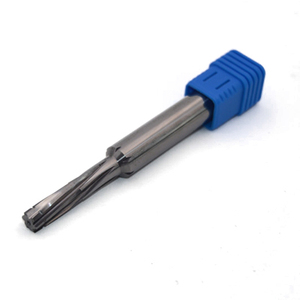
Solid carbide provides maximum static stiffness and chatter resistance, making it ideal for diameters below 12mm (0.500 in.). For diameters above 12mm, a brazed carbide tipped reamer fuses premium carbide cutting tips onto an alloy steel shank. This construction delivers carbide wear performance at the cutting edge while the tough steel body absorbs impact and shock, offering superior economy and fracture resistance during interrupted cuts.
Yes. Our engineering division produces fully custom OEM reamers according to client drawings. Capabilities include multi-diameter step reamers, pilot-guided port reamers (e.g., SAE J1926, MS33649), Morse taper shank reamers, non-standard inch/metric decimal sizes, and adjustable expansion hand reamers for automotive fitting shop applications.
Standard catalog tools maintain stock for immediate shipment. For custom OEM geometry or private-label orders, typical lead times range from 2 to 3 weeks for samples and 4 weeks for volume production batches. MOQs are flexible—ranging from 5 to 10 pieces for large diameter solid carbide/tipped reamers, and 50 to 100 pieces for standard HSS hand reamers.