
Rock River Tool, Inc.Precision Cutting Tools
Technical Support(800) 345-8924
Talk to an Engineer In high-precision sub-millimeter machining, 3D relief carving, PCB prototyping, and heavy industrial non-ferrous milling, tool geometry and substrate metallurgy dictate overall yield and surface roughness ($R_a$). As a premier China wholesale engraving bit supplier and exporter, our production matrix integrates ultra-fine sub-micron tungsten carbide matrices ($0.4\,\mu\text{m}$ grain size), sintered Polycrystalline Diamond (PCD) cutting edges, and physical vapor deposition (PVD) titanium/diamond-like coatings (DLC).
Operating under rigorous ISO 9001:2015 quality management standards, our manufacturing facility leverages 5-axis CNC grinding centers (ANCA and Rollomatic) paired with Zoller Genius 3 inspection systems. By holding dynamic total indicator reading (TIR) runout to under $\le 0.003\text{mm}$, our rotary engraving cutters, V-bits, single-flute aluminum mills, and PCD stone carving tools deliver exceptional feed rate performance, reduced tool deflection, and extended edge longevity in severe production environments.
Explore our flagship standard and custom-engineered engraving router bits, optimized for CNC routers, industrial engraving units, and high-speed machining centers.
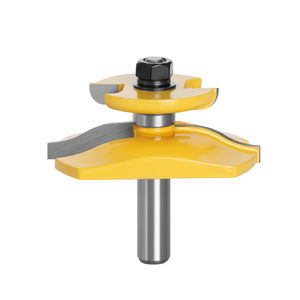
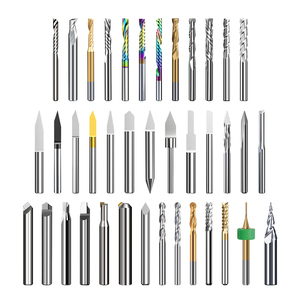
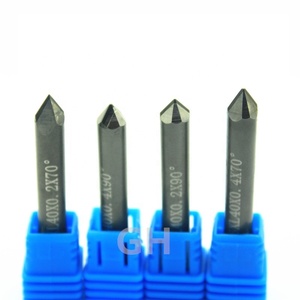
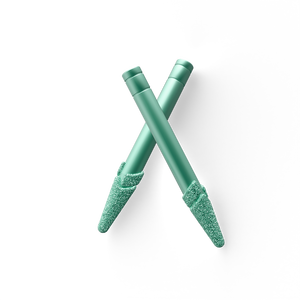
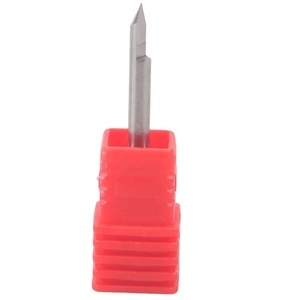
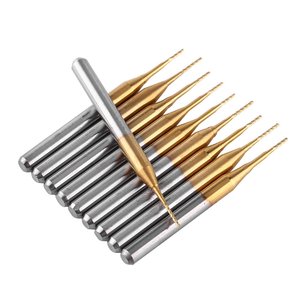
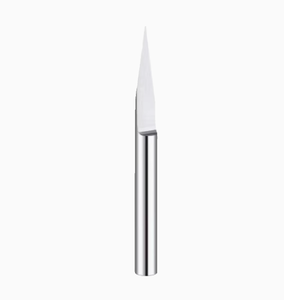
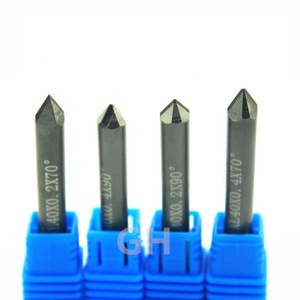
The operational efficiency of CNC engraving is governed by the shear stress dynamics at the tool-workpiece interface. Selecting the correct cutter substrate requires evaluating material hardness, thermal conductivity, dynamic chatter elasticity, and chip evacuation physics.
Standard cutting tools often utilize medium-grain carbide ($1.2\,\mu\text{m} - 2.0\,\mu\text{m}$), which suffers from micro-chipping under cyclic impact forces. Our premium engraving bits utilize sub-micron ($0.4\,\mu\text{m} - 0.6\,\mu\text{m}$) tungsten carbide grains bound with a 10% - 12% Cobalt matrix. This yields a Transverse Rupture Strength (TRS) exceeding $4,000\,\text{N/mm}^2$ and a hardness of $HRA\, 92.5 - 93.8$, ensuring exceptional resilience against lateral tip breakage during fine V-carving.
For abrasive non-metallic and mineral substrates—such as granite, marble, sintered ceramic, and carbon fiber reinforced polymers (CFRP)—carbide suffers rapid abrasive wear. Sintering a layer of polycrystalline diamond directly onto a carbide shank under ultra-high pressure and temperature ($1,500^\circ\text{C}$, $6\,\text{GPa}$) creates an edge with a Knoop hardness of $\approx 50\,\text{GPa}$. PCD tooling maintains razor sharpness up to 50 times longer than uncoated carbide in stone engraving applications.
To reduce thermal degradation during dry or MQL (Minimum Quantity Lubrication) cutting, our tools feature tailored thin-film coatings:
To optimize feeds, speeds, and tool selection across diverse industrial substrates, review our empirical application matrix derived from real-world manufacturing trials:
| Tool Type / Geometry | Target Workpiece Material | Spindle Speed (RPM) | Feed Rate (mm/min) | Max Depth of Cut (DOC) | Coolant Strategy |
|---|---|---|---|---|---|
| Solid Carbide V-Bit ($10^\circ - 90^\circ$) | Brass, Aluminum, Acetal, PCB | 18,000 - 24,000 | 800 - 1,800 | 0.1mm - 0.5mm / pass | Dry / Air Blast / MQL |
| Single Flute Spiral Cutter | Acrylic, PVC, Aluminum Sheet | 16,000 - 22,000 | 1,500 - 3,500 | 1.0D - 1.5D | Air Blast / Mist Coolant |
| PCD Conical / 3D Relief Tool | Granite, Marble, Sandstone | 10,000 - 16,000 | 600 - 1,200 | 0.2mm - 0.8mm / pass | Continuous Flood Water |
| 2-Flute TiN Micro-End Mill | Mild Steel, Stainless Steel (304) | 12,000 - 18,000 | 400 - 900 | 0.05D - 0.2D | Oil Mist / High-Pressure Flood |
| Raised Panel Ogee Router Bit | Hardwood, MDF, Plywood | 12,000 - 16,000 | 3,000 - 6,000 | Full Profile in 2-3 passes | Dust Collection System |
As global manufacturing shifts toward automation, high-speed micro-machining, and green production processes, the engraving tooling sector is undergoing rapid technology transitions.
With electronics miniaturization and micro-fluidics expanding, demand for cutter tip widths down to $0.05\text{mm}$ with sub-micron edge radii is growing rapidly. Advanced grinding techniques ensure zero micro-burr generation on delicate traces.
Modern CNC spindles operating at 40,000 to 100,000 RPM require balanced tool designs (G2.5 balance rating) to eliminate high-frequency vibration, preserve spindle bearings, and deliver optical-quality surface finishes.
Integrating diamond coatings via chemical vapor deposition directly onto complex 3D carbide geometries allows full 5-axis relief carving in ultra-hard ceramics and stone composites without geometric distortion.
For industrial buyers, OEM tool distributors, and large-scale machining facilities, sourcing engraving bits from China has evolved beyond simple unit-cost procurement. Today, enterprise buyers prioritize total cost of ownership (TCO), supply chain resilience, and customizable engineering support.
Off-the-shelf catalog bits frequently require feeds-and-speeds compromises. Leading enterprise buyers work directly with our engineering division to co-design bespoke geometries—optimizing flute helix angles, relief angles, neck taper clearances, and specialized coating formulations tailored to exact workpiece alloys.
Global manufacturers demand batch-to-batch repeatability. Our quality assurance framework mandates optical contour checks, hardness testing, dynamic balance verification, and laser engraving of serial numbers directly on tool shanks for 100% digital traceability.
Environmental regulations and plant safety standards are accelerating the phase-out of traditional flood coolants. Modern procurement specs mandate tools optimized for dry cutting or Minimum Quantity Lubrication (MQL), utilizing polished flutes and thermal-barrier coatings.
To mitigate international logistics risks, we provide enterprise partners with flexible VMI (Vendor Managed Inventory) agreements, safety buffer stocks, and expedited 7-day custom prototype tooling turnarounds.
Combining decade-spanning tooling expertise, robust raw material partnerships (sourcing ultra-fine carbide rods from top-tier metallurgical plants), and direct technical support, we empower distributors and machine shops globally.
Get immediate insights into common engineering and purchasing inquiries managed by our technical sales team.
Tip breakage on micro-engraving bits ($< 0.5\text{mm}$ flat bottom width) is primarily driven by dynamic runout (TIR), excessive plunge rates, or machine spindle vibration. Mitigation strategies include ensuring high-precision toolholders (ER collets with $< 0.005\text{mm}$ accuracy), utilizing ramped or helical entry paths rather than straight Z-plunges, and upgrading to sub-micron carbide grades with higher Transverse Rupture Strength (TRS).
PCD tools should be specified when machining abrasive non-metallic materials such as granite, marble, quartz, glass-reinforced plastics, and high-silicon aluminum. While carbide wears down rapidly due to abrasion, PCD maintains tip integrity up to 20 to 50 times longer. However, PCD should not be used on ferrous metals (steel, iron) due to chemical affinity reactions at elevated cutting temperatures.
For custom geometries, special shank dimensions, or non-standard coating specifications, sample prototypes are typically produced within 7 to 10 working days upon CAD drawing approval. Full production batch runs (1,000 to 50,000 pieces) require approximately 15 to 25 calendar days, supported by expedited air freight or ocean shipping options.
Single-flute (uniflute) geometry provides exceptionally large chip valley clearance. Soft materials such as acrylics, PVC, and soft aluminum alloys generate long, gummy chips that clog multi-flute tools. The single flute allows rapid chip ejection, minimizing heat buildup and preventing material welding (built-up edge) to the cutting edge.
Yes, we provide sample evaluation packages for qualified B2B buyers, distributors, and OEMs. You can test our standard or customized engraving bits directly on your CNC machinery to benchmark edge life, feed rate capabilities, and surface finish against your current tooling supplier.
Looking for reliable wholesale pricing, factory-direct quality assurance, or custom tool engineering? Contact our application engineers today to discuss your technical drawings and sourcing requirements.
Inquire Now