
Rock River Tool, Inc.Precision Cutting Tools
Technical Support(800) 345-8924
Talk to an Engineer Explore our elite range of high-speed steel and solid carbide machine reamers, engineered for extreme hole accuracy, superior surface finish, and extended tool life.
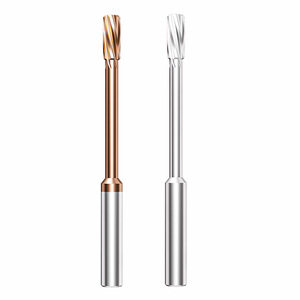
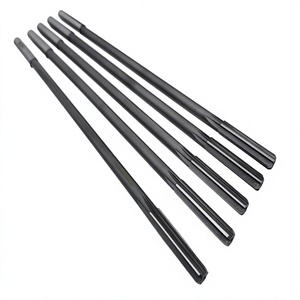
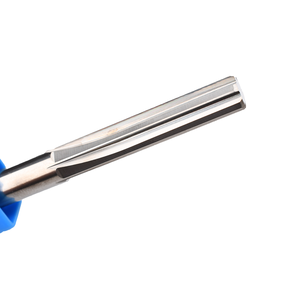
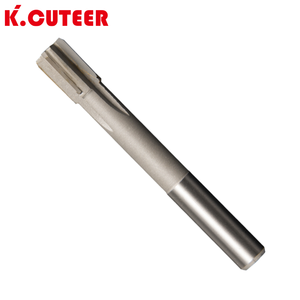
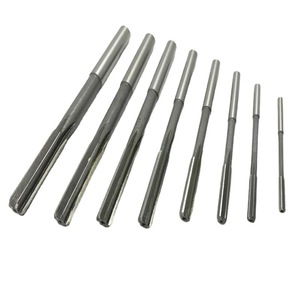
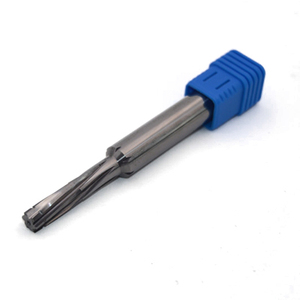
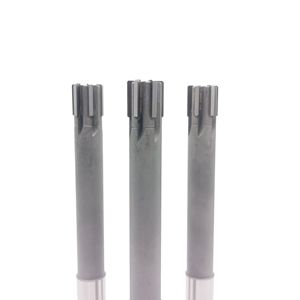
Decades of specialized grinding expertise, advanced metallurgical metallurgy, and strict quality assurance make us the premier OEM source for high-precision taper reamers.
We utilize C-2 (883 grade) micro-grain tungsten carbide for cast iron, aluminum, and non-ferrous alloys, alongside C5/C6 (370 grade) premium carbide for alloy steels, ensuring maximum wear resistance and edge integrity.
Every taper reamer exported from our factory undergoes 100% optical profile inspection and laser micrometer validation, adhering strictly to EU Machinery Directive compliance and international DIN 1420 reaming tolerances.
Combining the elasticity and shock absorption of hardened tool steel shanks with premium carbide cutting edges allows our reamers to absorb heavy chatter during interrupted cuts while keeping per-hole costs extremely low.
Send us your DXF/STEP drawings for step-reamers, custom taper angles (Morse, Taper Pin, 1:50, 1:10), special pilot diameters, internal coolant channels, or non-standard flute helix angles. We quote within 24 hours.
From multi-layer AlTiN for heat resistance in dry cutting to smooth Bronze PVD and DLC (Diamond-Like Carbon) coatings for anti-galling performance in aluminum machining, our surface engineering maximizes tool life.
Equipped with automated multi-axis ANCA and Walter CNC cutter grinders, our production facility guarantees reliable high-volume contract manufacturing, custom laser marking, and fast express shipping worldwide.
Precision reaming represents the crucial final machining pass in mechanical manufacturing, where dimensional accuracy, geometric roundness, taper alignment, and surface texture are elevated to micron-level tolerances. In modern industrial contexts—spanning aerospace turbomachinery, automotive transmission housings, hydraulic valve manifold blocks, and heavy directional drilling equipment—achieving consistent H7 or H6 hole tolerances demands a rigorous understanding of tool geometry, substrate dynamics, and thermal behavior.
This technical whitepaper, curated by our senior tooling application engineers, outlines the engineering principles behind CE certified taper reamers, solid carbide machine reamers, and custom-brazed cutting tools. It provides procurement directors and CNC engineers with actionable intelligence to optimize tool selection, mitigate chatter, and reduce total cost per hole.
Taper reamers differ fundamentally from standard cylindrical chucking reamers. While straight chucking reamers remove material primarily along their entry chamfer angle, a taper reamer engages material continuously along its entire inclined cutting edge. This continuous contact generates significant radial thrust forces and friction along the flute length, requiring specialized cutting geometry to avoid wedge binding and tool chatter.
Selecting the optimal substrate configuration requires balancing structural rigidity against fracture toughness and procurement cost:
| Substrate Configuration | Core Composition | Flexural Strength (TRS) | Ideal Application Domain | Procurement Advantage |
|---|---|---|---|---|
| Solid Micro-Grain Carbide | WC + 6-10% Co (Grain size 0.4–0.6 µm) | 3,800 - 4,200 MPa | High-speed CNC machining, small diameters (<12mm), tight H6 tolerances. | Maximum dynamic stiffness; zero bond line distortion. |
| Brazed Carbide Tipped (C2 / C5) | Premium Carbide Tip + Alloy Steel Body | 2,400 MPa (Steel Shank) | Large diameters (>14mm), interrupted cuts, older non-rigid CNC machines. | High shock tolerance; reduced cost per tool by 35-50%. |
| Cobalt High-Speed Steel (HSS-E / M35) | Fe-Cr-Mo-V Alloy + 5-8% Cobalt | 3,200 MPa | Manual reaming, deep hole hand reaming, portable magnetic drilling units. | Maximum fracture toughness; immune to thermal shock vibration. |
As detailed above, brazed carbide tipped taper reamers offer a distinctive mechanical advantage in large-diameter applications. By locating micro-grain tungsten carbide exclusively along the cutting edge, the tool retains the high wear resistance of carbide while utilizing the ductile steel shank to absorb bending moments and damp harmonic vibrations.
Global manufacturing is undergoing a structural transition driven by automation, sustainability mandates, and digital product verification. Procurement executives sourcing CE certified cutting tools must align their vendor networks with three primary macroeconomic and technological trends:
Environmental regulations and high fluid disposal costs are forcing machine shops to shift away from flood coolant toward MQL or completely dry machining. This transition requires reamers equipped with internal coolant micro-channels and advanced thermal barrier coatings such as AlTiN (Aluminum Titanium Nitride) or Bronze PVD coatings. These coatings maintain chemical stability at operating temperatures exceeding 900°C, preventing adhesion and built-up edge (BUE).
European and North American buyers are increasingly mandating full material traceability for imported cutting tools. CE certification in tooling ensures compliance with vibration safety, raw material non-toxicity (RoHS/REACH), and manufacturing consistency. Forward-thinking factories are embedding laser-etched matrix codes on reamer shanks, allowing automated tooling cabinets to instantly read heat numbers, grind dates, and micro-tolerance calibration maps.
To reduce cycle times in high-volume production lines (such as electric vehicle transmission cases), contract manufacturers are abandoning multi-tool sequences in favor of single-pass combination tools. Custom step-reamers—which execute pilot drilling, taper reaming, chamfering, and face spot-facing in a single spindle stroke—are replacing standard catalog items. Partnering with a factory capable of rapid custom grinding (2-3 week lead times) is becoming a critical competitive advantage.
Achieving optimal hole surface finish (Ra < 0.4 µm) requires running taper reamers at precise cutting parameters. Unlike twist drills, reamers remove small radial stock (typically 0.15mm to 0.35mm on diameter) and require higher feed rates coupled with moderate surface speeds to maintain chip load control.
| Workpiece Material Group | Hardness Range | Solid Carbide Vc (m/min) | HSS-Co Vc (m/min) | Feed Rate per Rev (mm/rev) | Recommended Coolant Strategy |
|---|---|---|---|---|---|
| Unalloyed Carbon Steel (C45 / 1045) | 180 - 230 HB | 40 - 65 | 15 - 22 | 0.10 - 0.25 | Soluble Synthetic Oil (8-10%) |
| Alloy Steel / Tool Steel (4140 / D2) | 25 - 38 HRC | 25 - 45 | 8 - 14 | 0.08 - 0.18 | High-Pressure Neat Cutting Oil |
| Grey Cast Iron & Ductile Iron | 160 - 250 HB | 50 - 80 | 18 - 28 | 0.15 - 0.35 | Dry Air Blast / MQL |
| Aluminum Alloys (Si < 6%) | 60 - 120 HB | 80 - 140 | 30 - 50 | 0.20 - 0.50 | Emulsion Oil with Anti-BUE Additives |
| Austenitic Stainless Steel (304 / 316) | 180 - 240 HB | 20 - 35 | 6 - 12 | 0.08 - 0.15 | High-Pressure Soluble Oil (>12%) |
Clear, authoritative technical answers to assist machine shop managers, tool buyers, and supply chain specialists.
CE certification verifies that our taper reamers and industrial cutting tools comply with essential European Union health, safety, and environmental protection standards (specifically Machinery Directive 2006/42/EC). For international buyers, it guarantees structural substrate integrity under maximum rated torque, non-hazardous raw material composition, precise labeling, and rigorous factory quality control.
Brazed carbide tipped reamers are ideal for hole diameters larger than 12mm to 14mm, interrupted cutting environments (such as cross-holes or keyways), and older CNC machinery with moderate spindle runout. The alloy steel shank provides elasticity to prevent catastrophic tool shattering, while the carbide tip provides long cutting life at a significantly lower purchasing cost. Solid carbide is preferred for small diameters (<12mm) and ultra-rigid high-speed machining where maximum dynamic stiffness is essential.
For cylindrical reaming, a radial stock allowance of 0.10mm to 0.20mm (0.004" to 0.008") is recommended for diameters up to 12mm, and 0.20mm to 0.35mm (0.008" to 0.014") for larger diameters. For taper pin reamers, the pre-drilled stepped hole diameter must be carefully calculated so that the small end of the taper reamer pilot enters freely without forcing material, while ensuring uniform stock removal along the taper length.
Yes. As a direct OEM manufacturer, our plant operates multi-axis ANCA CNC grinding centers and optical profile inspection equipment. We produce custom step reamers, non-standard taper angles (e.g., 1:10, 1:16, 1:50, or special angles), custom pilot diameters, coolant-through shanks, and specific corner radii. Simply upload your CAD drawings (DXF/STEP/PDF) through our contact portal for a rapid engineering quote.
Straight flutes offer maximum tool core rigidity and are easy to re-sharpen, making them suitable for general-purpose blind hole finishing in cast iron or short-chip materials. Spiral flutes (typically 7° to 15° left-hand helix with right-hand cut) provide smooth continuous shearing action, superior chip evacuation in deep through-holes, and effectively eliminate chatter marks when crossing keyways or internal splines.
Standard catalog reamers are stocked for immediate dispatch within 48 hours. Custom engineered tools carry a typical manufacturing cycle of 2 to 3 weeks. All tools are packaged in anti-corrosive VCI plastic tubes, cushioned with protective foam, and labeled with custom barcodes or your private brand artwork upon request. Air express shipping (DHL/FedEx/UPS) delivers to Europe, North America, and Australia within 3 to 5 business days.
Whether you require standard stock chucking reamers, heavy-duty directional drilling fluted tools, or custom solid carbide step reamers engineered to your exact tolerances, our engineering team is ready to support your production line.